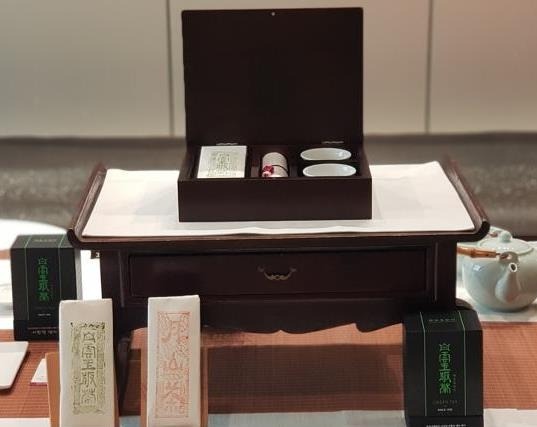
Baegun Okpan Tea of Gangjin
Photo courtesy of Gangjin County. Redistribution and database use prohibited.
GANGJIN, South Korea (Yonhap News Agency) — Reporter Yeo Un-chang
Baegun Okpan Tea, a traditional green tea from Gangjin, Jeollanam-do, has attracted attention after being showcased near the closing ceremony venue of the 2019 World Aquatics Championships in Gwangju.
According to Gangjin County on August 1, an event titled “The Story of Korean Tea” was held on July 28 near the championship's closing ceremony venue. The event was jointly organized by the Asia Culture Center (ACC) in Gwangju and the Korea Tea Culture Design Institute.
The event introduced a variety of traditional Korean teas, including Baegun Okpan Tea, Matcha, Hwangcha (yellow tea), Chunseol Tea, and Choui Tea.
Baegun Okpan Tea is recognized as Korea's first commercially marketed green tea brand, originating during the Japanese colonial period.
The tea takes its name from Okpanbong Peak in Baegundong, Gangjin, where the tea leaves used in its production were harvested.
Baegun Okpan Tea is believed to have originated around 1920, a period when movements encouraging the consumption of domestically produced goods, such as the Korean Products Promotion Movement, were gaining momentum.
The historical background of Baegun Okpan Tea is also closely associated with the independence movement. Lee Heum, an elder relative who greatly influenced tea master Lee Han-young, the creator of Baegun Okpan Tea, maintained close ties with members of Jasinhoe, an anti-Japanese organization established to eliminate the five Korean officials who had supported the Eulsa Treaty of 1905.
Lee Gae-ho, then Minister of Agriculture, Food and Rural Affairs, also visited “The Story of Korean Tea” event, offering encouragement to participants and expressing his commitment to supporting the preservation and revitalization of Korean tea culture.
Park Si-jong, Chairman of the Better Gwangju Research Institute, stated, “Baegun Okpan Tea is remarkable not only for its exceptional aroma but also for the deeply moving history and stories behind it.”
He added, “We will continue working to promote the value of Korea's traditional tea culture.”
Source: Yonhap News Agency
Reporter: Yeo Un-chang
Published: August 1, 2019, 17:38 KST
Contact: betty@yna.co.kr
Copyright © Yonhap News Agency. All rights reserved. Unauthorized reproduction and redistribution prohibited.



Baegun Okpan Tea of Gangjin
Photo courtesy of Gangjin County. Redistribution and database use prohibited.
GANGJIN, South Korea (Yonhap News Agency) — Reporter Yeo Un-chang
Baegun Okpan Tea, a traditional green tea from Gangjin, Jeollanam-do, has attracted attention after being showcased near the closing ceremony venue of the 2019 World Aquatics Championships in Gwangju.
According to Gangjin County on August 1, an event titled “The Story of Korean Tea” was held on July 28 near the championship's closing ceremony venue. The event was jointly organized by the Asia Culture Center (ACC) in Gwangju and the Korea Tea Culture Design Institute.
The event introduced a variety of traditional Korean teas, including Baegun Okpan Tea, Matcha, Hwangcha (yellow tea), Chunseol Tea, and Choui Tea.
Baegun Okpan Tea is recognized as Korea's first commercially marketed green tea brand, originating during the Japanese colonial period.
The tea takes its name from Okpanbong Peak in Baegundong, Gangjin, where the tea leaves used in its production were harvested.
Baegun Okpan Tea is believed to have originated around 1920, a period when movements encouraging the consumption of domestically produced goods, such as the Korean Products Promotion Movement, were gaining momentum.
The historical background of Baegun Okpan Tea is also closely associated with the independence movement. Lee Heum, an elder relative who greatly influenced tea master Lee Han-young, the creator of Baegun Okpan Tea, maintained close ties with members of Jasinhoe, an anti-Japanese organization established to eliminate the five Korean officials who had supported the Eulsa Treaty of 1905.
Lee Gae-ho, then Minister of Agriculture, Food and Rural Affairs, also visited “The Story of Korean Tea” event, offering encouragement to participants and expressing his commitment to supporting the preservation and revitalization of Korean tea culture.
Park Si-jong, Chairman of the Better Gwangju Research Institute, stated, “Baegun Okpan Tea is remarkable not only for its exceptional aroma but also for the deeply moving history and stories behind it.”
He added, “We will continue working to promote the value of Korea's traditional tea culture.”
Source: Yonhap News Agency
Reporter: Yeo Un-chang
Published: August 1, 2019, 17:38 KST
Contact: betty@yna.co.kr
Copyright © Yonhap News Agency. All rights reserved. Unauthorized reproduction and redistribution prohibited.